

News
Polyester vs Nylon for Compression Shirts: Lab Data
# Polyester vs Nylon for Compression Shirts: Lab Data From Our Factory Floor
When you run a small brand, the fight over polyester vs nylon for compression shirts usually happens at 9 p.m. in front of a quote sheet, not in a lab. We see it weekly: an Amazon seller compares two factory quotes and asks why one long-sleeve compression shirt costs $1.70 more per unit. Another founder waits on a fabric sample and watches their launch date slip. The difference between those two fibers shows up in unit cost, stretch recovery, pilling test results, and lead time—and we've measured all four on our own floor in Zhejiang for over 20 years.
We're Alpinario, an OEM/ODM factory, not a trading company. We built this comparison from the 170 GSM to 260 GSM rolls in our fabric library and from the data our QC team logs during bulk cutting. This will not tell you that one fiber "wins." It will tell you which one fits the order you are about to place. If you want the full picture of how we run production, start on our [sportswear manufacturer](https://www.alpinario.com/sportswear-manufacturer) page.
## Fiber basics
At the yarn supplier level, the two fibers start to separate. Polyester filament—we buy 75D for compression bodies—arrives at roughly $4.20/kg from our Zhejiang yarn vendors. Comparable 70D nylon runs about $5.60/kg. That raw price gap follows the yarn all the way to the finished garment.
Polyester is hydrophobic. Water molecules don't penetrate the fiber, so moisture evaporates fast and the fabric feels dry. That's why most of our 80/20 polyester/spandex compression shirts use an open-mesh structure to push sweat out quickly. Nylon is hydrophilic. It absorbs moisture and feels smoother and less sticky at the beginning of a workout. But once nylon saturates, it dries slower.
On the knitting floor, both fibers run on our circular and warp-knit machines, but they heat-set differently. Polyester holds its shape at a higher setting and takes disperse dye at about 130 °C. Nylon needs a lower heat-setting budget, uses acid dye near 100 °C, and is more sensitive to overstretching during stentering. Our QC team logs both in the same pilling book, and they can usually tell which rolls are nylon just by touching the surface.
Here are the constructions we commonly pull for compression shirt clients:
- 180 GSM mini-mesh, 80% polyester / 20% spandex — budget, ventilated, used for muscle tees
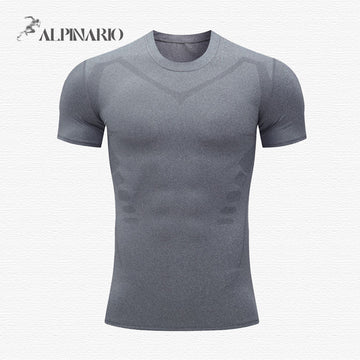
- 200 GSM warp knit, 80% polyester / 20% spandex — standard tight-fit training top
- 220 GSM warp knit with brushed back, 78% nylon / 22% spandex — smoother hand for higher-touch lines
- 240 GSM double-knit, 82% polyester / 18% spandex — heavier control for posture and recovery wear
## Performance comparison table
Numbers move faster than adjectives when you're comparing quotes. The table below is the one we pull up for clients visiting our showroom. It compares the two most common compression fabrics in our library: a 200 GSM polyester warp knit with 20% spandex and a 190 GSM nylon warp knit with 22% spandex. FOB estimates assume a long-sleeve shirt with raglan sleeves, a heat-transfer logo, no print, at 300–500 pieces.
| Metric | Polyester compression fabric | Nylon compression fabric |
|---|---|---|
| Typical GSM in our library | 170–260 | 180–240 |
| Stretch & recovery | 4-way, ~92–95% recovery after 30-min rest | 4-way, ~88–92% recovery after 30-min rest |
| Moisture behavior | Hydrophobic; dries fastest; dry hand | Absorbs moisture; silkier initial feel; longer dry time |
| Pilling after 20 lab washes | Martindale grade 4–5 | Martindale grade 4; slightly more surface fuzz |
| Fabric cost per kg | $5.80–7.20 | $7.20–9.00 |
| Dyeing / heat-setting | Disperse dye at ~130 °C; color-stable | Acid dye at ~100 °C; lower energy, more handling care |
| Feel | Dry, crisp | Smooth, silkier |
| FOB per piece (300–500 pcs) | $5.90–7.40 | $7.00–8.90 |
Read the FOB row carefully: it assumes the same cutting line, the same trims, and the same QC steps. The gap between rows is real, but it is not the $1.70 some buyers quote from memory—it's roughly $1.10 to $1.50 at the order sizes our clients actually place. If your target FOB is under $6.20, nylon will be hard to justify at 300 pieces. If your customer expects a silky slip-on feel and your retail price can support an $8.00-plus FOB, polyester will feel like the cheaper product in a side-by-side touch test.
## Cost & MOQ impact
Cost is not just fabric price. It's fabric, dyeing, cutting waste, trims, sampling, and the number of pieces you're willing to order. Here's how the total plays out on our factory floor:
1. **Fabric consumption:** A long-sleeve compression shirt uses about 0.28 kg of knit fabric. At the $1.40–1.80/kg cost gap above, the fiber choice adds roughly $0.40–0.50 to the nylon bill of materials.
2. **Sampling:** Our MOQ is 1 piece. That is not a marketing line; it is how we run sample lines. You can order one polyester shirt and one nylon shirt, compare them yourself, and have both in hand within 3–7 days after production.
3. **Bulk reorder:** After sample approval, a 300-piece order ships in 4–6 weeks. We do not force startups to jump to 1,000 pieces to get a reasonable unit price. A 300-piece run is enough to test FBA listings, pre-orders, or a first wholesale drop.
4. **FBA prep:** If you sell on Amazon, we pre-apply FBA labels and ship to the warehouse directly. That removes one repacking step from your cost sheet and roughly three to five days from your timeline.
Buyers often assume that a 1-piece MOQ means higher sampling fees. It doesn't at our factory. We charge cut-and-sew time on the sampling floor, not a MOQ penalty. Our [low-MOQ sportswear process](https://www.alpinario.com/low-moq-sportswear) page explains how we staff one-off orders without disrupting bulk production.
One cost detail that surprises clients: the decoration method changes the total more than the fiber does. A heat-transfer logo on polyester is the lowest-cost route. Embroidery adds stiffness on a stretch fabric, so we usually advise against it on compression bodies. A woven label at the hem costs little but makes a garment feel more finished. Those small choices affect your per-unit price by $0.30 to $0.80, so decide them before you compare polyester vs nylon pricing.
## Which to pick per product
Different sales channels have different margin math. Here's how we guide clients when they sit in our meeting room:
- **Amazon sellers and startups targeting under $30 retail:** Start with polyester at 200 or 220 GSM. It keeps FOB between $5.90 and $7.40, it prints cleanly, and it holds shape during storage. If the listing works, add a nylon capsule later.
- **Boutique activewear brands selling on feel:** Go nylon at 190 GSM. The silkier hand justifies the $7.00–8.90 FOB, but only if your customers can touch the product before buying. Online-only brands rarely capture that touch advantage in photos.
- **Gym chains and team orders:** Polyester, 220 GSM. You need Pantone-matched colors across size runs and repeat orders. Polyester's dye behavior at 130 °C gives us consistent color batches, and the lower cost per unit matters when a gym orders 300 pieces across six colorways.
- **Recovery wear and low-impact training:** Nylon performs better against the skin for users who want a warm, smooth layer, not a cool dry-touch layer. This is the difference between a compression shirt worn under a kit and one worn as a base layer for yoga or mobility work.
- **Unsure buyers:** Order 300 pieces in polyester first, then 150 in nylon. Keep the design and trims identical. Your sales data will tell you whether the touch difference converts to revenue. We can run both fabrics from the same pattern file with no additional development cost.
For more depth on compression-specific construction, our product team has documented the cuts, bindings, and fabric options on the [compression shirts page](https://www.alpinario.com/pages/compression-shirts). Use it as a spec reference when you brief us.
## FAQ
**Which feels more premium?**
Nylon, in almost every blind touch test we run. A 190 GSM nylon/spandex warp knit feels smoother, cooler to the skin, and drapes better than a polyester knit at the same weight because nylon filaments are finer. Polyester feels dry and crisp, which athletes often describe as "sporty" rather than "luxurious." The honest factory answer: if your customer buys after touching, nylon earns its extra $1.10–1.50 per unit. If they buy from a thumbnail on Amazon, they cannot feel the difference, so polyester is the rational choice.
**Which lasts longer?**
For normal gym use, the gap is smaller than most buyers expect. Polyester resists UV and chlorine better, so it lasts longer in outdoor training, pool workouts, and repeated sun exposure. Nylon has higher breaking tenacity but shows slightly more surface fuzz in our pilling logs after 20 washes. In our experience, both fibers survive 50-plus wash cycles when the spandex content is 18–22% and the care label is followed. The seam construction and the elastic thread usually determine the garment's real lifespan, not the fiber. If your product goes near chlorine or strong sun, choose polyester. If it lives indoors and the softness drives repeat purchases, choose nylon.
Before you approve any fabric, test it on your own body. One piece is enough. Send us your target price, GSM, artwork, and expected order quantity—we will reply within 24 hours with cost options for both fibers. If your order needs Amazon prep, tell us and we'll include FBA labeling in the quote. You can also browse our [private label activewear](https://www.alpinario.com/private-label-activewear) setup to see the customization steps that follow fabric selection.
[Request a Quote](mailto:support@alpinario.com) — we'll have your polyester and nylon cost comparison ready tomorrow.