

News
Compression Shirt Manufacturing Cost: Full 2025 Pricing
# How Much Does It Cost to Manufacture Compression Shirts?
You have the spec sheet ready. The fabric swatch is approved. But before you send the PO, you ask yourself the question every brand founder gets stuck on: *how much does it cost to manufacture compression shirts when you factor in freight and tariffs?*
We get this question daily on our floor in Zhejiang. Buyers often compare three quotes from different suppliers and assume the lowest FOB price wins. Then the shipment lands, the customs broker sends the duty bill, and the actual landed cost is 18% higher than planned. That mismatch kills margins.
So let’s break down what a factory’s quote actually includes, what it hides, and how you can calculate your true landed cost before committing to production. We’ve been running this factory for over 20 years, and we’ll walk you through the exact numbers we use when quoting compression shirt orders—from yarn to your Amazon warehouse.
---
## Cost anatomy of compression shirts
A compression shirt looks simple. It’s a tight-fitting top. But the manufacturing cost is split into five distinct buckets, and each one behaves differently as your order quantity scales.
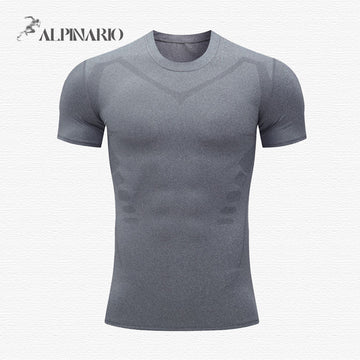
Here is the breakdown for a standard men’s compression shirt (polyester-spandex, 200 GSM, raglan sleeves, no flatlock stitching) at a 300-piece order:
| Cost Component | Unit Price (USD) | % of Total | Notes |
|---|---|---|---|
| Fabric (knitted, dyed, finished) | $2.10 | 37% | Includes circular knit, pre-shrink, dye lot |
| Cutting & Sewing Labor | $1.85 | 33% | Includes flatlock seams, hemming, neck rib |
| Trims & Packaging | $0.45 | 8% | Hang tag, poly bag, size sticker, recycled carton |
| Factory Overhead & QC | $0.60 | 11% | Cutting waste, machine depreciation, inline inspection |
| Factory Margin | $0.62 | 11% | Our profit, which funds new machines and QC training |
| **Total FOB Ningbo** | **$5.62** | **100%** | For 300 pcs, size run S-XXL |
If you order 3,000 pieces, the unit price drops to roughly **$4.10–$4.40**. Why? The fabric supplier gives us a better rate per kilogram, the cutting markers are optimized to reduce fabric waste from 8% down to 4%, and the sewing line runs for consecutive days without re-setup. We pass those savings to you.
If you order just 1 piece—which we can do because our factory has **no minimum order quantity**—the unit cost jumps to **$18–$25**. That seems absurd until you realize we have to program the cutter, load one roll of fabric, and spend three days on sampling. For startups testing a design, that 1-piece order is a cheap insurance policy compared to a 300-piece gamble.
Now, here is the part most buyers miss: **the FOB price only tells you what happens at the factory gate.** The real question is what the shirt costs when it arrives at your door in Los Angeles or Hamburg. That includes sea freight, insurance, customs duties, and local trucking. We’ll get to that, but first, let’s explain the single biggest cost driver: fabric.
---
## Fabric cost drivers
Compression shirts demand four-way stretch, moisture wicking, and recovery. That means you are buying engineered fabric, not commodity cotton. The fabric cost depends on three things: **GSM (weight), yarn type, and finishing treatments.**
Here are the current price ranges we see from Zhejiang mills for compression-grade fabric:
- **160 GSM polyester/spandex (80/20):** $3.20–$3.80 per kg. This is lighter, for yoga or running. Less compression power.
- **200 GSM polyester/spandex (75/25):** $3.80–$4.40 per kg. The industry standard for training tops. Most of our compression shirt orders use this.
- **230 GSM nylon/spandex (70/30):** $5.20–$6.00 per kg. Nylon costs more, but it feels smoother and compresses harder. Serious athletes prefer it.
- **Gradient or engineered knit (zones of different compression):** $7.00–$9.00 per kg. Requires a specialized knitting machine and longer lead time.
A 200 GSM shirt in size L weighs about 150 grams. So one shirt uses **0.15 kg of fabric**, which costs roughly **$0.62**. But you also lose 6–8% of fabric during cutting (marker waste, end pieces, defects). So realistic fabric cost per shirt is **$0.67–$0.72** at 300 pieces, and lower at scale.
The finishing treatments add another layer of cost. We routinely quote these add-ons:
- **Anti-odor silver ion finish:** +$0.35 per shirt. The chemical bath adds a processing step.
- **UPF 50+ treatment:** +$0.20–$0.30 per shirt.
- **Brushed inner face (for winter):** +$0.25 per shirt. Requires a napping machine.
- **Reflective piping or logos:** +$0.15–$0.50 depending on the tape width.
Our advice: don’t add every finish to your first order. A basic 200 GSM compression shirt with a heat-transfer logo costs **$4.80–$6.20 FOB** in moderate quantities. That’s good enough to sell at $35 retail. If you want to see how different fabric options compare visually, check our [custom sportswear page](/custom-sportswear) — it lists the actual swatch cards we mail out.
---
## Including Shipping And Duties
Here is the gap between factory quotes and landed costs. We ship thousands of compression shirts to Amazon FBA warehouses and boutique retailers every month, so we’ve seen the full cost stack. Let’s run a real example.
**Order: 1,000 compression shirts, 200 GSM, total weight 180 kg, volume 2.5 CBM.**
**FOB Ningbo price: $5.20/unit = $5,200.**
Now add shipping:
1. **Sea freight (LCL, Ningbo to Los Angeles):** $180–$250 per CBM in a consolidated container. At 2.5 CBM, that’s **$450–$625** total.
2. **Insurance and export documentation:** **$40–$80** total.
3. **U.S. customs duty (HTS 6114.30, synthetic fiber apparel):** **11.5% ad valorem** on the FOB value. That’s **$598**.
4. If your goods ship to the EU, the duty rate is **12%** plus VAT (usually 20%+ depending on country), which you reclaim later if registered.
5. **Trucking from port to your warehouse or Amazon FC:** **$150–$300** depending on distance.
Add it up: **$5,200 + $550 + $60 + $598 + $200 = $6,608.** Your true landed cost per shirt is **$6.61**, not the $5.20 on the quote.
The duty calculation deserves extra attention. A common trap is buying from a trading company that says "low price" but declares a different HTS code. Compression garments with a "compression" function can sometimes be classified as medical/support hosiery (HTS 6115) with lower duty, but only if the product has a documented medical claim. For general athletic wear, assume **11.5% in the U.S.**, **12% in the EU**.
You can reduce freight cost per unit by ordering more at once. The same 1,000-shirt order packed into 2.5 CBM costs roughly $0.60 per shirt in freight. If you double the order to 2,000 shirts (same box density), freight per shirt drops to $0.35. Our sales team can repack your cartons to maximize container utilization—it’s a free service we offer to all clients. For a full explanation of how we handle bulk international logistics, read our [sportswear manufacturer guide](/sportswear-manufacturer).
---
## Quote comparison table
Not all compression shirt suppliers are factories. Many are trading companies that outsource to factories like ours. We prepared a transparent comparison based on what buyers typically experience when sourcing from the three main supplier types. These are real ranges we’ve seen on quotes from our customers’ RFQs over the last five years.
| Factor | Trading Company | Direct Factory (Tier 2) | Direct Factory (Alpinario) |
|---|---|---|---|
| FOB price per unit (300 pcs) | $6.20–$7.50 | $5.20–$6.00 | $4.80–$5.80 |
| MOQ | Usually 300–500 pcs | 100–500 pcs | **1 piece** |
| Sampling time | 7–15 days | 5–10 days | **3–7 days** |
| Sampling cost (refundable with order) | $80–$120 | $50–$80 | **$30–$60, refundable** |
| Production lead time (300 pcs) | 6–8 weeks | 4–7 weeks | **4–6 weeks** |
| Response time | 2–3 days | 24–48 hours | **Within 24 hours** |
| Who actually sews your shirt? | Unknown (subcontractor) | Same factory | **Our own floor** |
| FBA labeling / drop ship service | Sometimes | Rarely | **Yes, pre-applied FBA labels** |
The table shows our numbers, but the takeaway is broader: **a higher quote from a direct factory can be cheaper than a lower quote from a trading company** because the factory controls the supply chain. When you work with us, you talk directly to the production manager who assigns your job to a sewing line. There is no middleman fee, and no one is relaying questions between you and the actual manufacturer. Our [low MOQ sportswear page](/low-moq-sportswear) explains how we keep the line running profitably even with small orders.
---
## FAQ
**What is the typical price range for manufacturing compression shirts?**
At order quantities of 300–1,000 pieces, expect **$4.50–$6.50 per shirt FOB** from a Chinese factory, depending on fabric weight (160–230 GSM), finishes, and label complexity. Larger orders of 3,000+ pieces typically drop to **$3.80–$4.80**. If you order just 1 sample piece, budget **$18–$25** because of setup and labor. Add roughly **20–30%** to your FOB price for shipping and duties to get your real landed cost.
**What raises unit cost most?**
Fabric choice. Swapping a 200 GSM polyester/spandex for a 230 GSM nylon/spandex can add **$1.20–$1.50 per shirt**. The second biggest factor is order quantity — moving from 100 to 500 pieces typically reduces unit cost by **15–20%** because fabric waste drops and sewing lines run continuously. The third factor is custom branding: embroidered logos are more expensive than heat-transfer prints, and woven labels cost more than printed labels. If your budget is tight, we often recommend starting with a heat-transfer logo and a printed neck label. That saves roughly $0.80 per shirt versus embroidery plus woven labels.
---
Every quote is a story of choices. You can choose cheap fabric and high freight, or better fabric and smarter production planning. You can order 50 pieces from a trading company and pay $8 each, or you can order 1 piece from our factory, test it for $25, and find your real pride.
We are a Zhejiang factory that has sewn sportswear for over 20 years. We reply within 24 hours, we sample in 3-7 days, and we can pre-stick FBA labels so your boxes go straight to Amazon. There is no minimum order, and there is no pressure to order 1,000 pieces before you trust our work. Ask us the question on your mind: *what would this specific shirt cost, landed at my door?*
Request a Quote: [support@alpinario.com](mailto:support@alpinario.com) — include your target GSM, quantity, and destination country, and we’ll send a full landed-cost breakdown within one business day.