

News
Low MOQ Compression Shirts for Amazon Sellers
# Low MOQ Compression Shirts for Amazon Sellers: Why 1-Piece Samples to 100-Piece Runs Work
You’ve got the listing copy written, the PPC budget set, and a placeholder image that you’re tired of looking at. The real blocker is inventory. You ask a supplier for 50 compression shirts, and they quote you a price that’s three times what you planned to sell them for. Or they tell you the MOQ is 1,000 pieces, which means a $4,000 bet on a product that hasn’t seen a single verified review.
That’s the operational problem we solve. I run the floor at Alpinario, a 20+ year factory in Zhejiang. We’re not a trading company, and we don’t do minimum order quantities. You can send us a photo of a shirt you like, and we’ll sew one piece, ship it to you in 3 to 7 days, and you can hold it in your hands before you commit to a single production unit. This article is about the math that makes that model work for you, and for us.
## Why low MOQ exists (factory perspective)
Most buyers assume a factory demands high MOQs because the sewing machines need constant work, or the fabric supplier forces bulk orders. That’s partially true, but it misses the real reason. The MOQ is a tool to protect the factory’s margin, not a fixed law of physics.
At our factory, we run multiple production lines. One line might be cutting 2,000 running vests for a German brand, while another line is stitching 20 custom shirts for a startup in Austin. Our overhead—the rent, the machine maintenance, the QC team salaries—is already paid for by the large orders. Accepting a small order doesn’t cost us a new machine or a new building. It costs us the time to switch the line, the labor for a short run, and the admin work of explaining production details. We simply price those costs into the small batch.
Think about fabric for a second. A typical order of 100 compression shirts in a 160 GSM polyester-spandex blend might use about 30 kilograms of fabric. We buy fabric rolls in thousands of kilograms from our suppliers. When you order 30 kilos, we pull it from stock we already have, or we order a roll and keep the remainder for the next small client. There is no waste, because there is always a next small client. That’s the key insight—low MOQ works economically when the factory has a steady stream of small orders to absorb the leftover materials.
We also cut and sew your order on a separate station, not on the main high-speed line. This "off-line" production is how we keep the cost low without disrupting the big orders. Our cutting master, Chen, lays out the fabric for your 100 pieces manually. He doesn’t use the computerized cutter for a single layer layout; that would take too long. He uses a straight knife and a paper pattern. It’s slower, but for 100 pieces, the labor time is only about 1.5 hours. The cost is absorbed into the unit price.
The real reason other factories quote high MOQs is that they don’t have a system for handling small orders efficiently. They lose money on them, so they push you to order more. We designed our workflow around the 1-piece sample and the 100-piece test run. It’s a separate production flow with its own pricing logic. That’s why our MOQ is 1 piece, and why we can confirm a quote within 24 hours. We’re not doing you a favor; we’ve just built the machinery to handle it.
## Price math: 1pc vs 50pc vs 500pc
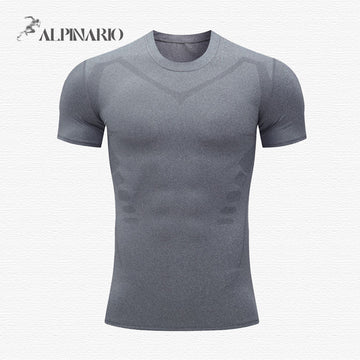
Let’s put real numbers on the table. These are approximate USD prices for a standard men’s compression shirt, 160 GSM, 75% polyester / 25% spandex, with a heat-transfer logo and a woven neck label. Your exact price depends on size runs, fabric color (we can match almost any Pantone), and print complexity. But this gives you a baseline for your landing cost.
| Order Size | Unit Price (USD) | Sample Lead Time | Production Lead Time | Key Cost Driver |
|---|---|---|---|---|
| 1 piece (sample) | $25 - $35 | 3-7 days | N/A | Cutting setup, fabric cut loss, single-piece sewing |
| 50 pieces | $9.50 - $12.50 | 3-7 days for pre-production sample | 2-3 weeks | Manual cutting, short sewing line, label setup |
| 500 pieces | $6.80 - $8.50 | 3-7 days for pre-production sample | 4-6 weeks | Bulk fabric roll, automated cutting, full line efficiency |
Why is the 1-piece sample so expensive? Because we have to pull a small piece of fabric, set up the pattern, and have a senior tailor sew it. The sewing alone takes about 45 minutes. The packaging, the polybag, and the shipping label are fixed costs. The price isn't about the fabric; it’s about the specialist labor.
The jump from 1 piece to 50 pieces is where the economy kicks in. The labor time per piece drops because the sewer repeats the same operation 50 times. The cutting layout is more efficient—we can nest the patterns to use less fabric per shirt. The fixed costs (label setup, thread changes, factory QC check) get spread across the run. That’s why the unit price drops by about 60% when you move from 1 to 50 units.
The jump from 50 to 500 is less dramatic in percentage terms, but it’s where the real profit margins hide for an Amazon seller. At $6.80 to $8.50 per unit, you can hit a breakeven cost at a sale price of $19.99 to $24.99, which is the competitive zone for compression shirts on Amazon. You’re also in a position to order 500 pieces in a wider size curve—S, M, L, XL, XXL—which prevents stockouts on your best-selling size. We ship FBA-ready, meaning we’ll pre-apply the FBA labels and send directly to the Amazon warehouse, so you don’t have to handle the goods twice.
## Test-order playbook
A low MOQ is worthless if you don’t have a plan to use it. Here is the step-by-step sequence we recommend to every Amazon seller who works with us. It’s designed to minimize your risk and maximize your learning speed.
**Step 1: The 1-piece verification (Week 1)**
Send us your artwork, a reference photo, or a competitor’s shirt you want us to reverse-engineer. We’ll respond with a quote within 24 hours. We’ll send you a digital proof of the logo placement, and if you approve, we sew the sample. You’ll receive it in 3 to 7 days. Your goal here is not to sell anything. It’s to verify the fabric feel, the seam construction, and the fit. Wear it to the gym. Wash it three times. See if the logo cracks or the fabric pills.
**Step 2: The 50-100 piece foot-in-the-door (Week 2-4)**
Once the sample is approved, order 50 to 100 pieces. This is not a money-making order. It’s a market-test order. Use it to create a real Amazon listing with actual photos, run a small PPC campaign, and see if anyone clicks "Add to Cart." With 100 pieces, you have enough inventory for about 30 days of sales if you’re ranking for a mid-tail keyword. We’ll need about 2-3 weeks to produce and deliver this. During this time, you should be writing your listing copy and preparing your brand registry.
**Step 3: The SKU rationalization (Week 4-6)**
Look at your sales data. Which size is selling? Is it overwhelmingly Large, or are you selling more Medium? For compression shirts, we often see a skew towards M and L for men, and S and M for women. Cut your slowest-moving size in the next order. Keep your best-seller among the colors. This data is gold, and you only got it because you were willing to start with a small batch.
**Step 4: The reorder trigger (Week 6+)**
Set a rule for yourself. When you have 2 weeks of inventory left, place the reorder. The production lead time for a 300-piece order is 4-6 weeks, so you need to plan ahead. At this stage, you order in the 500-1000 piece range, and you use the price break from the table above to improve your margin.
## Scaling path
The transition from a 100-piece test to a 5,000-piece production run is not a jump; it’s a staircase. We’ve walked hundreds of clients up these steps, and the ones who skip stairs usually fall. Here’s how the scaling path looks from our side.
**Stage 1: The Artisan Stage (1-100 pieces)**. Everything is manual. Cutting is by hand, sewing is on a single machine, and QC is a visual check. This stage is for validation, not profit.
**Stage 2: The Batch Stage (300-500 pieces)**. This is where we move you to a dedicated small-batch production cell. We can use a semi-automated cutter for bulk fabric layers, which reduces your unit cost. The production lead time is 4-6 weeks. We can do customized hang tags, polybag printing, and FBA labeling. This is your first "real" profitability stage. You’re big enough to matter to us, but small enough that a failed colorway isn’t a disaster.
**Stage 3: The Bulk Stage (1,000+ pieces)**. At this volume, we start negotiating fabric prices with our textile mills directly. We can dye fabric to your exact Pantone reference, instead of using stock colors. We can set up a dedicated production line for your SKU, which reduces labor time per piece. Our QC team will do an inline inspection during production, not just a final check. This is where you compete on price with established brands.
**Stage 4: The Priority Stage (3,000+ pieces)**. You get allocated production slots. We hold fabric inventory for you in our warehouse. You get weekly production photos and a dedicated account manager. Your order ships FOB Shanghai or direct to Amazon FBA.
We don’t force you to Stage 2 before you’re ready. The scaling path is flexible. Some clients stay at 500 pieces per colorway because they have a niche market. That’s fine by us. Our factory needs diverse order sizes to keep the floor busy, and a steady stream of 500-piece orders is just as profitable as a few large ones. The key is that you control the pace.
## FAQ
**Is 1 piece really possible?**
Yes. We say "MOQ: 1 piece" and we mean it. We have a specific production protocol for single-piece samples: our pattern master drafts the pattern, the cutting master pulls the fabric, and a senior sewer completes the garment. The unit price is higher—roughly $25 to $35 for a basic compression shirt—because the labor is specialized and the setup is manual. But the goal is to let you see and feel the final product before you commit to a production budget. It removes the biggest fear in sourcing: ordering a thousand shirts that look nothing like the digital mockup. The 1-piece sample is our sales pitch, and our proof of workmanship.
**Price per piece at low volume?**
For a 50-piece order of a standard compression shirt in a 160 GSM polyester-spandex blend, expect to pay between $9.50 and $12.50 per piece. At 100 pieces, the price drops slightly, to approximately $8.50 to $11.00 per piece if the design is simple. At 500 pieces, the price falls to $6.80 to $8.50 per piece. These prices include the basic sewing, one logo application, and a woven neck label. They exclude shipping and any custom packaging. If you add a complex sublimation print or a multi-panel construction, the price will move up.
**Can you guide me on FBA labeling?**
Yes. We do this every week. You provide the FNSKU labels, or we generate them from your Amazon account. We apply them to the polybag or the product itself, and we ship directly to the Amazon warehouse address. We handle the carton labeling too. You just send us the inbound placement plan from Seller Central, and we pack to that specification.
**Do you do custom colors for low MOQ?**
We can do almost any Pantone color, but the lead time changes. Stock colors ship immediately. Custom-dyed fabric requires us to order yarn or fabric from the mill, which adds 1-2 weeks to the production timeline. For a 100-piece order, we recommend sticking to our stock colors (usually black, navy, white, and grey) to keep the lead time at 2-3 weeks. For 500-piece orders, custom dyeing is more practical because the fabric mill will accept a small dye lot.
---
We designed our entire workflow—from the 1-piece sample to the 100-piece test run—around the reality that most Amazon sellers don’t have a warehouse full of cash. The path is simple: verify the sample, test the market, scale the winner. We handle the rest.
**Request a Quote** to get your specific price breakdown and lead time. Send us your artwork or reference photo, and we’ll reply within 24 hours.