

News
Start an Activewear Brand: Price for Wholesale Margins
# How to Start an Activewear Brand and Price for Wholesale Margins
You built a clean Shopify store, three mockups, and a color palette. Then the first quote arrives and your landed cost is 40% higher than the spreadsheet assumed. The sample lead time pushes your launch past Q4. And now you are quietly asking whether the “factory” you found on a B2B platform is actually a trading company with a rented showroom.
That operational stretch—between the product idea and the unit economics that make it viable—is where most activewear brands stall. We have run our own factory floor in Zhejiang for over 20 years, and we see brand founders walk in with the same three questions every time: how long does sampling take, is the MOQ real, and how do I price for wholesale margins without losing money? This guide walks through it in the order it actually happens, with the checklists we use on our own cutting and sewing floor.
## Positioning & line planning
Before we cut a single sample, we ask for your line plan. You do not need twenty styles; you need three to five that fit one promise. A gym owner launching a training apparel brand needs a different lineup than an Amazon seller chasing bestseller rank in compression tops.
Here is our factory-side checklist for the planning call:
1. **Define the user and the environment.** CrossFit client training five days a week? Spec 190–220 GSM with flatlock seams and higher nylon content for stretch recovery. Yoga studio? Buttery drape at 180–200 GSM, minimal compression, wide waistband. Runner? Lightweight 150–170 GSM, mesh panels, reflective options.
2. **Pick a hero style and a repeater style.** The hero gets your marketing budget; the repeater carries wholesale volume. Most of our first-time buyers put their margin into one great legging or compression shirt, not a full catalog.
3. **Set the retail price bracket before you pick fabric.** For a $45–$58 retail legging, your wholesale target should sit at roughly $22–$29. That number drives every downstream decision, from yarn count to trims.
4. **Kill SKUs early.** Our MOQ is 1 piece per style, per colorway, per size, so you can test tiny. But every extra SKU multiplies the sampling route: pattern, print, wash label, packaging. Start with 2–3 colors, not 8.
5. **Lock the sizing matrix before sampling.** Changing size specs after production starts costs days and money. Send us your size chart, or we will build one from your target market’s measurements.
The numbers on our side are simple: send us reference images and Pantone colors, and we ship samples in 3–7 days. A 300-piece medium order ships 4–6 weeks after sample approval. You should not wait six months to launch a test collection.
## Finding a manufacturer
A showroom in the city is not a factory. A company that cannot tell you which yarn supplier they use is a trader. We are a 20+ year activewear factory in Zhejiang—cutting room, sewing lines, and QC benches under one roof. When you brief us directly, you are not layering a trader’s commission into your unit price.
Here is a comparison table based on what our buyers tell us after their first sourcing round:
| Check | Direct factory (Alpinario) | Trading company | Overseas factory |
|---|---|---|---|
| MOQ flexibility | 1-piece custom | Usually 100–300 pcs/style | Often 500+ pcs/style |
| Sampling time | 3–7 days to ship | 7–14 days after relay | 2–4 weeks plus shipping |
| Communication | Direct, reply within 24h | Middleman edits messages | Timezone and schedule gaps |
| 300-piece production | 4–6 weeks after sample approval | 6–9 weeks | 10–16 weeks plus customs |
| FBA support | Pre-applied labels, direct Amazon shipment | Usually not available | Requires consolidation |
When you evaluate any supplier, use this audit checklist. Ask for the factory address and check whether the building matches the “factory floor” photos. Ask for the MOQ in writing. Ask for a 3-day prototype. Ask for one order to ship with FBA labels already applied. Our standard answers never change: 1-piece MOQ, 3–7 day sampling, 4–6 weeks for 300 pieces, 24-hour response time. If any of those numbers feels unusually good, ask to video call the floor—we will walk you past the cutting tables and show you the rolls of fabric. Our [private-label activewear](https://www.alpinario.com/private-label-activewear) page lays out exactly how label, tag, and packaging options map to different order quantities.
## Sampling & fit sessions
Sampling is the cheapest insurance you will ever buy. One sample costs you a few days of waiting, not a container of dead inventory.
The sampling checklist we give every new client:
1. **Send a complete brief.** Reference images, flat measurements, fabric weight in GSM, trims, label requirements, and a target wholesale price. The more detail, the fewer revision rounds.
2. **We cut a proto in 3–7 days and ship it to your door.** If you need a photo or video first, we send that too.
3. **Run a real fit session.** Test the garment, not just the mirror. Squat, lunge, overhead reach, and run through a wash cycle. A legging that survives the first wash but pills after the third is a future return problem.
4. **Mark your revisions precisely.** Seam length, rise height, waistband pressure, label placement, stitch tension. Our team replies to revision comments within 24 hours.
5. **Sign off on the sealed sample.** The production clock starts only after that approval, so nothing is ambiguous when we cut 300 pieces.
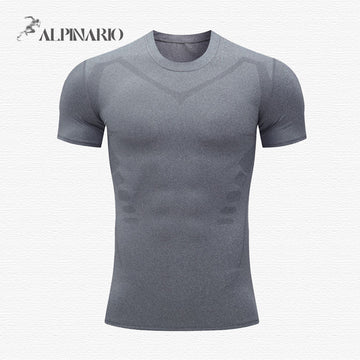
Numbers that matter here: sample dispatch in 3–7 days, 24-hour reply to your revision notes, and 300-piece production in 4–6 weeks after approval. We cut predominantly in polyester, with nylon options for compression lines. Pantone matching covers nearly any color, and your logo can be printed, embroidered, or heat-pressed. Wash labels, neck labels, hang tags, and FBA stickers can all be applied before the carton leaves our floor. Compression shirts are one of our most common first orders—see our [compression shirt production guide](https://www.alpinario.com/pages/compression-shirts) for the fit details buyers usually ask about.
## And Price For Wholesale Margins
Here is the math most new brands mess up. They take a factory quote of $9.50 per unit and naively set wholesale at $18, expecting a 50% margin. Then freight, import duties, payment processing, packaging, Amazon referral fees, and free-shipping round the landed cost up to $14.20, and the real margin is 21%—before warehouse damages, returns, and ads.
Use this factory-side checklist to price for wholesale margins correctly:
1. **Get the complete quote in writing.** Fabric, trims, labels, hang tags, polybag, carton, and QC. Ask what is included and what is not.
2. **Calculate landed cost.** Unit price plus freight, duties, payment fees, and warehouse handling. For small test orders, add 10–20% on top of the unit price for these costs. A larger 300-piece run compresses that ratio.
3. **Add a margin buffer of 8–12%** for returns, minor defects, and promo discounts. If you are an Amazon seller, calculate the FBA referral fee and fulfillment fee separately—do not let those eat your wholesale margin.
4. **Set wholesale from retail backwards.** Standard trade practice is wholesale at 45–55% of retail. A $58 legging retails at about $28 wholesale. A $38 sports bra retails at about $18 wholesale.
5. **Verify your final margin:** (Wholesale − landed cost − buffer) ÷ Wholesale. If that number sits under 35%, go back to step 1 and change something small—fabric weight, trim scope, or packaging—before you commit to hundreds of pieces.
Here is a worked example on our floor. Suppose your target retail is $52 for a leggings line. Wholesale at 50% of retail is $26. Landed cost with freight, duty, labels, and packaging is $12.80. Buffer at 10% of wholesale is $2.60. Margin before ads: (26 − 12.80 − 2.60) ÷ 26 = 40.8%. That is a healthy, bankable wholesale margin.
Cost levers you can pull to protect that margin:
- **Reduce SKUs.** One style in three colors beats three styles in one color. Fewer patterns, fewer trim purchases, fewer sampling routes.
- **Standardize sizing.** Shared block patterns across styles cut fabric utilization waste on the cutting table.
- **Choose polyester-dominant fabric.** High-nylon blends feel great but cost more per meter. Fabric is the biggest line item on any quote.
- **Consolidate packaging.** We can pack to your FBA spec so you skip re-boxing in a warehouse later.
Because our MOQ is 1 piece, you can validate this margin calculation with a real production run instead of a spreadsheet fantasy. Our [wholesale sportswear program](https://www.alpinario.com/wholesale-sportswear) uses this exact pricing format, so you build your margin model on the same numbers we quote.
## Launch & first reorder
Launch is not the finish line. The first reorder is where your brand becomes real.
The launch sequence we recommend to every first-time buyer:
1. **Order 300 pieces of your hero style** once the margin math holds at 40% or better.
2. **We pre-apply FBA labels and ship directly to an Amazon warehouse.** No extra storage touch, no re-boxing fee, no double freight.
3. **Keep your sealed sample and compare every batch.** We do the same on our QC bench before anything leaves the factory.
4. **Track sell-through weekly.** Target 30% sell-through in the first month before you commit to a larger reorder.
5. **Reorder before stockout.** With a 4–6 week production lead time, place your second order when you have 10–12 weeks of inventory left, not when Amazon shows the low-stock warning.
Your first reorder can be as small as 300 pieces because our MOQ is still 1 piece. In fact, we expect your second order to be smarter than your first: fewer colors, tighter sizes, and better fabric choices based on real sell-through data. If you want to launch with even less risk, our [low-MOQ sportswear](https://www.alpinario.com/low-moq-sportswear) page covers one-piece test runs and reorder patterns in detail.
## FAQ
**How much capital to start?**
A lean launch is doable with $3,000–$8,000. That covers a 300-piece production run of one style at roughly $8–$14 per unit, sampling fees, packaging, freight, and basic product photography. The 1-piece MOQ means you can spend under $300 to test three sample variations before committing to production.
**How many styles for launch?**
Three to five styles max—but one is better than five for a first production. Our buyers who launch with one hero style in two colorways order 300–600 pieces, launch, and reorder within 6–8 weeks. The ones who launch twenty SKUs usually burn their margin on unsold sizes.
**Domestic vs overseas factory?**
A domestic factory in your country gives you faster shipping and easier communication, but typically at a higher unit price. An overseas factory like ours gives you 20+ years of manufacturing scale, fabric sourcing, and cost efficiency—but you must account for freight, duties, and longer lead times in your margin math. We close that distance gap with 24-hour responses, video floor walks, 3–7 day sampling, and FBA pre-labeled direct shipping.
Ready to run the numbers on your first line? [Request a Quote](mailto:support@alpinario.com) and we will send you a complete unit price with all the variables you need to price for wholesale margins.