

News
FBA-Ready Activewear Manufacturing: Operational Guide
# FBA-Ready Activewear Manufacturing: From Our Floor to Your Amazon Doorstep
A buyer called us with a painful story last season. They found an activewear supplier charging USD 0.70 less per unit than its competitors, placed a 300-piece order, and sent it to a prep center for Amazon. When the 3PL opened the cartons, 160 units had no scannable FNSKU label, and the other 140 had labels stuck over the seams of poly bags, making them unreadable. The re-labeling bill came to USD 1.80 per unit. The product also lost its Prime placement window.
That is not a price problem. It is a process problem.
We are Alpinario, a sportswear factory in Zhejiang with more than 20 years on our own production floor. We are not a trading company. When you order FBA-ready activewear manufacturing from us, the barcode work, carton specs, and inventory prep are handled before the boxes leave our dock—not after they arrive at a warehouse. Here is exactly how that works, step by step.
## FBA Labeling
Amazon does not receive your inventory because the garment looks good. It receives your inventory because the unit barcode scans correctly. For most sellers using FBA, that means an FNSKU label—not the retail UPC/EAN code in your product listing—must sit on every single unit.
On our production floor, FBA labeling is not an afterthought. The label application happens on the packing line, right after our final inspection, using this sequence:
1. You send the FBA label file or the FNSKU sheets from your Seller Central shipment plan. If you generated the plan with the “Amazon labels” option, those are the exact barcodes we apply.
2. Our labeling worker affixes one FNSKU label per poly-bagged unit. Labels go on the outside of the bag, flat, never over a seam, fold, or edge that could distort the barcode.
3. If the garment has a hang tag with your brand logo, the label can also go on the back of that tag. For bagless items, that is often the most scan-friendly position.
4. The floor supervisor pulls 25 units randomly across a 300-piece batch and scans each one three times with a handheld reader. If a single barcode fails twice, we stop the line and check the label batch.
5. We record the scan date, the batch number, and the operator name for each production run. That record stays in our factory file for one year, so if Amazon flags a unit, we can trace it to the exact packing hour.
FBA-ready activewear manufacturing does not stop at the FNSKU. If your private label includes your own woven neck label or a printed size tag, we also confirm that the size on the tag matches the size in the barcode. Size mismatches are a common reason Amazon marks units as “unsellable.” We check collar labels, hang tags, and poly bag stickers before the carton is sealed.
Our per-unit prep charge for FBA labeling is small—typically USD 0.05 to USD 0.20 per unit depending on the order size and whether you also want poly bags, size stickers, or hang tags. On a 300-piece order that is often less than the cost of one hour of your own staff’s time. If you are comparing that against a cheaper quote from a trading company, ask them one question: which person on their floor is trained to scan an FNSKU? We have at least four.
For a deeper look at the order types we run through this line, see our [wholesale sportswear](https://www.alpinario.com/wholesale-sportswear) overview. And if you are launching with a tiny first batch, our [low-MOQ sportswear](https://www.alpinario.com/low-moq-sportswear) guide explains how the same QC process works on orders as small as one piece.
## Carton Specs
Here is where good factories and sloppy traders part ways. A carton that weighs 26 kg will be rejected or flagged at an Amazon fulfillment center even if every unit inside is perfect. We keep our FBA carton specs tight, because Amazon’s receiving team does not have time to be generous.
The table below compares the three routes most activewear brands use to get inventory into Amazon, including the cost and risk of each.
| Route | Who applies FNSKU labels | Typical added time | Typical added cost per unit | Main operational risk |
|---|---|---|---|---|
| Factory direct to Amazon (our FBA-prep line) | Our QC line, during production | 0–2 working days inside production | USD 0.05–0.20 | Low; we scan before cartons close |
| Ship to a 3PL prep center first | Third-party warehouse staff | 5–10 extra days | USD 0.30–0.80 plus storage fees | Mislabeled units, repacking delays |
| Ship to your own office, relabel yourself | You or your team | 7–14 extra days | Your labor, tape, printers, plus freight | Backlog, human error, lost sales window |
When we build cartons for direct-to-Amazon shipments, these are the specifications our floor follows:
- **Gross carton weight stays below 22.7 kg.** For a typical 180–220 GSM polyester activewear order, that usually means 50–70 units per carton. We never fill a carton to the top just to save cardboard.
- **We use 5-ply export cartons** for Amazon-destined goods, not the single-wall boxes we might use for domestic retail orders. Garments are dense, and a collapsing carton creates damage claims.
- **The FBA box label is applied to the outside top of the carton**, on a clean, flat panel. We never place it over tape, over a previous label, or on a corner where the barcode can wrap.
- **Each carton gets a clear packing list inside**, separate from the master carton label, showing the FNSKU count, size ratio, and carton number.
- **If a carton contains mixed sizes**, we note that on the outside label. Many FCs sort directly from the box, so that information saves your inventory from being misreceived.
One detail that surprises new sellers: we do not cover the FBA box label with wide transparent tape. Tape can create glare, and a scanner may struggle with a reflective surface. If the label needs protection, we tape only the top and bottom edges, never across the barcode.
For brands producing running wear, our [running wear wholesale guide](https://www.alpinario.com/pages/running-wear-wholesale-guide) includes the exact packing and labeling notes we recommend for speed-oriented product lines.
## Inventory Prep
Inventory prep is where the order-to-doorstep timeline gets real. As a factory, we can make great garments in four weeks, but if your inventory plan is wrong, “quick production” does not help you.
Here is the operational sequence we recommend to every Amazon seller that works with us:
1. **Send your product concept or reference sample.** This can be a drawing, a competitor’s garment, or a tech pack. We reply within 24 hours with a feasibility review and fabric suggestions.
2. **Order a sample.** Our sampling department ships within 3–7 days. That sample is made on the same pattern and production method we will use for the bulk order, not a separate “show sample” made by a master tailor.
3. **Approve the sample and confirm the order.** There is no minimum order quantity at Alpinario. A one-piece order is welcome for market testing, though for an Amazon launch, we usually discuss a 150 to 300-piece first run so the freight cost per unit does not eat your margin.
4. **Production takes 4–6 weeks** for a medium 300-piece activewear order after sample approval. We do not quote 3 weeks knowing that we will slip another 2 weeks; we quote the range we can actually hold.
5. **FBA prep runs during the final packing days.** Labels, poly bags, hang tags, and carton labeling are completed as part of the production schedule, not as a separate third-party step.
6. **Your cartons ship from our factory to your freight forwarder or directly to the Amazon fulfillment center.** We can apply the FBA box labels so your forwarder only needs to book the appointment.
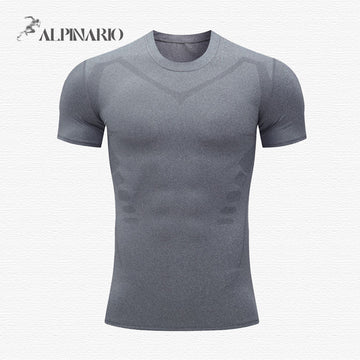
If you are selling compression tops, the test-fit properties matter more than the color matching. Read our [compression shirt factory notes](https://www.alpinario.com/pages/compression-shirts) before you approve a sample, because a 200 GSM flat knit and a 230 GSM structured knit perform very differently once the inventory is at Amazon and buyers start returning items they do not like.
On the inventory planning side, consider the total lead-time chain: sample approval, 4–6 weeks of production, sea freight of 15–30 days to the West Coast, plus 2–5 days for the FC to check in your cartons. A small air-freight first batch can keep you in stock while the slower ocean batch travels. That is the “operational cushion” that separates successful launches from stockout failures.
Our [private-label activewear](https://www.alpinario.com/private-label-activewear) process follows the same sequence for brands that want their own labels, wash instructions, hang tags, and Pantone-matched colors. Almost all Pantone colors can be matched in polyester, and nylon is also available for styles that need more structure.
### FAQ: What does it cost?
FBA-ready activewear manufacturing pricing depends on fabric weight, trim, and customization. A simple polyester sports top might fall in the range of USD 5.50–9.00 FOB per unit, while a more complex compression shirt with flatlock seams, printed logos, and full custom packaging can run USD 8.50–15.00 FOB per unit. Add roughly USD 0.05–0.20 per unit for FBA labeling and poly bag prep, plus the cost of any woven labels or hang tags. We send a written quotation within 24 hours of receiving your product details.
### What is the timeline?
Samples ship in 3–7 days. Once you approve the sample, a medium 300-piece order takes 4–6 weeks to produce. FBA prep adds only 1–2 working days inside that production window because labeling happens on the packing line. Ocean freight from China to the US West Coast usually adds 15–30 days, and air freight adds about 5–8 days. In short: budget 7–9 weeks from sample approval to an Amazon shelf if you ship by sea.
Send us your product idea, your existing sample, or your Amazon listing link. We will confirm the specifics and quote you within 24 hours. [Request a Quote](mailto:support@alpinario.com) and put your FBA inventory planning on a firmer schedule.