

News
Activewear Apparel Supplier for Amazon Sellers | Alpinario
# Activewear Apparel Supplier for Amazon Sellers: Sourcing, Price Breaks & Reorder Planning
Your landed cost per unit is never just the price on the quotation sheet. Add the sample revision, the production delay, the FBA prep fee, and the lost sales when your best-selling color runs out for nine days. That is the number that decides whether your listing makes money. We are Alpinario — the 20+ year Zhejiang factory that works as an activewear apparel supplier for Amazon sellers who need control over the whole pipeline. Our team replies to B2B inquiries within 24 hours. Samples ship in 3-7 days. A 300-piece medium order goes out in 4-6 weeks after sample confirmation. Before you place another PO with a trading company, let's look at how the sourcing workflow, price breaks, private label, and reorder planning work from the factory floor.
## Sourcing workflow
A clean sourcing workflow removes the two worst surprises: silent delays and spec drift. Ours is built for Amazon sellers who need dates they can plan against.
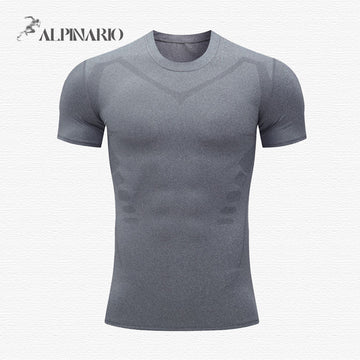
**Step 1: Send the reference (Day 0).** You send us a product photo, a sketch, a competitor sample, or just a link to your existing listing. If you only have a vague idea, we work from your description. Tell us the fabric feel, the fit, and the function — for example, a 150 to 220 GSM polyester with four-way stretch for a compression shirt.
**Step 2: Quotation within 24 hours.** Every B2B inquiry receives a reply within 24 hours on working days. The quote lists the unit price, the sample cost, the MOQ, and the production timeline. If you are comparing factories, this is the moment to ask about hidden costs: thread color matching, Pantone matching, label printing, and FBA labeling. We quote all of it up front.
**Step 3: Sample in 3-7 days.** Your sample ships within 3-7 days of confirming the quotation. For most activewear items — sports bras, leggings, tank tops, compression shirts — one round of sampling is enough. Some brands ask for two rounds: first a fit sample, then a labeled sample with final prints, wash care labels, and packaging. That adds roughly 3-5 working days per round.
**Step 4: Bulk production closes in 4-6 weeks.** After the sample is approved, a medium 300-piece order is produced and ready to ship in 4-6 weeks. Larger orders scale from there.
**Step 5: FBA preparation and direct shipping.** You don't touch the goods. We pre-apply FBA labels, attach poly bags if required, and ship directly to the Amazon warehouse address you provide. That removes an entire leg from your supply chain.
The workflow above matters especially for Amazon sellers because Amazon's inventory performance index punishes stock-outs. You are not just buying apparel; you are buying calendar certainty. That's what a factory that controls its own floor — not a trader reselling another plant's capacity — can offer. For a deeper look at custom construction options, see our [custom sportswear](/custom-sportswear) guide.
## Price breaks
Price breaks at our factory are structured around order size, but they are not a flat discount table. We quote by product spec, fabric weight, trims, and decoration method. For a basic polyester sports top in the 150-220 GSM range, the following tiers are typical starting points:
| Order tier | Order quantity | Unit price (USD) | Production lead time |
|---|---|---|---|
| Sample / color check | 1 pc | $25 – $45 | 3-7 days |
| Small batch | 100 pcs | $12 – $18 | 3-4 weeks |
| Medium order | 300 pcs | $8.50 – $13.50 | 4-6 weeks |
| Bulk reorder | 1,000+ pcs | $6.80 – $10.50 | 6-8 weeks |
The table covers a basic polyester top. A cut-and-sew legging with reflective trims or a lined sports bra moves up the range — materials and labor are calculated separately.
Three things about price breaks matter for Amazon sellers. First, the unit price at 300 pieces usually leaves healthy margin; the drop from 300 to 1,000 pieces is often $1.50-$3.00 per unit, which counts when you are running PPC on a $29.99 listing. Second, shipping is a fixed cost, so a larger order spreads freight across more units — your landed cost per unit keeps falling even after the factory price plateaus. Third, we hold the line on quality when you move up tiers. Our QC team checks every piece against the approved sample; a higher quantity does not loosen tolerances.
Mixing order tiers is also possible. You can combine activewear styles in one PO to reach a higher price break, as long as fabrics and trims are similar. If you are planning five colors of the same sports top, one 1,000-piece order across five colors often lands in a better price band than five separate 200-piece orders. Ask about the blended tier structure when you request a quote. Read our [wholesale sportswear](/wholesale-sportswear) page for the full overview.
## Private label at supplier tier
Being a private label supplier at the factory tier means we do what a trading company cannot: we change the product at the construction level, not just the label. Many brands approach us with "we want our logo on a blank." The factory-tier answer is, "great, but let's also check the seam construction, the elastic, and the pocket depth."
Here is what a typical private label project at our Zhejiang plant includes:
- **Logo application, three techniques**: print (印标), embroidery (绣标), and heat transfer (烫印). Your logo can go on the chest, the back, the waistband, or the hang tag.
- **Full label set**: wash care label, neck label, and hang tag, produced to your artwork and inserted into every piece.
- **Pantone-matched colors**: nearly all Pantone colors can be matched on polyester-dominant fabrics. Nylon is available when the product needs more sheen or compression.
- **MOQ of 1 piece**: private label is not gated behind a 300-piece minimum. The same 1-piece MOQ applies to custom-branded orders, which is rare in this industry.
- **Fabric range**: polyester-dominant jersey, interlock, and mesh are our home turf. Tell us the GSM you need and we source against it.
"Supplier tier" also changes your margins. A trading company quotes you its factory price plus 15-30 percent. A factory quotes its floor cost plus a margin. The difference shows up in two ways: lower unit prices and faster problem-solving. When a seam tension issue appears in the pre-production run, our QC team walks onto the floor and adjusts the machine settings. A trader would need three phone calls and a week to do the same. We are the [private label activewear](/private-label-activewear) manufacturer for brands that want packaging, labels, fit, and fabric controlled under one roof.
## Reorder planning
The first order is easy. You wait 4-6 weeks, you are excited, and you want more. The reorder is where Amazon sellers actually win or lose money. The math below is the reorder plan we give to every new brand.
**Step 1: Know your weekly velocity.** Pull the last 90 days of sales per color and size. Do not use total sales; use sell-through per size. A top-selling size running out loses the entire sale, not just part of it.
**Step 2: Calculate your runway.** Take your available inventory in the Amazon fulfillment center and divide it by your weekly velocity. If you have 600 units and sell 75 per week, your runway is 8 weeks.
**Step 3: Work backward from the runway.** Our lead time math for a reorder is: 3-7 days for a sample (if you want a revision) plus 4-6 weeks of production for a 300-piece order plus shipping to the Amazon warehouse. Add 1-2 weeks of safety margin for carrier delays, and a medium reorder placed 9-10 weeks before stock-out is the safe move.
**Step 4: Batch reorders to hit price breaks.** A 300-piece reorder every six weeks locks you into a higher per-unit price than a 1,000-piece reorder every fourteen weeks. You carry more inventory, but you save $1.50-$3.00 per unit. For a product selling 75 units per week, buying 1,000 pieces plus safety stock is usually the smarter balance.
**Step 5: Keep the same samples.** Reorders with no changes skip the sampling round entirely. The fastest reorder timeline we run is about 4-5 weeks, because the pattern, the trim, and the Pantone codes are already on file in the production system. That speed is the advantage of working with a factory rather than a trader.
Keep a digital folder with your approved samples, Pantone codes, logo files, and label artworks. Send that folder with your reorder PO. It cuts our internal preparation time dramatically and protects you if your usual contact is unavailable. For seasonal test runs and early-stage brands, our [low MOQ sportswear](/low-moq-sportswear) page explains the options in more detail.
## FAQ
**What is the MOQ?**
Our MOQ is 1 piece. That is not a marketing hook; it is our workflow. You can order a single piece to test fit and fabric. Once you are satisfied, the same low threshold applies to production orders — custom labels, Pantone colors, and all. Many factories gate samples at 20-30 pieces. We do not. We would rather earn your first small order and grow it into systematic reorders.
**What is the sampling timeline?**
Samples ship within 3-7 days of confirming the quotation. If you approve the sample immediately, a medium order of 300 pieces is produced and shipped in 4-6 weeks. If revisions are needed, each round adds roughly 3-5 working days to the sample stage. For a reorder without design changes, there is no sampling round — production starts from the saved specs and ships faster.
Ready to run the numbers on your next activewear order? Send us your artwork, your target price, and your Amazon sales velocity. We will reply within 24 hours with a quotation that includes unit price, sample cost, MOQ, and production dates.
[Request a Quote](mailto:support@alpinario.com)